Tuesday, 15 October 2019

Workshops

I have been able to run workshops at lots of different venues from schools to festivals to museums. I really enjoy working in the community and helping people unlock their creative potential and helping them find the therapuetic value of practicing textile skills. The workshops often create valuable spaces for people to socialise in a low pressure environment, giving people a primary focus, helping to reduce anxiety. I also find that giving people a project provides acheivable goals, distraction from day to day problems and a practical way to expel fidgety energy without the extreme levels of energy needed for excercise. I truly believe in the power of textiles as a universal tactile language. My proudest teaching achievement would be the volunteering for York Nurturing Community and Refugee Action York on a project called "Space2Sew". This project was a weekly session providing a safe space for refugee and other vulnerable women to learn sewing skills, which we soon realised most of these women possessed. They requested to learn to crochet so that they could make traditional lace to personalise their hijabs. I was able to to teach 5 ladies with only a few shared words of English and Arabic in only 3 hours. This experience was incredibly gratifying and I would love more opportunities to use textiles to support and enhance communities.
I truly value the challenge of figuring out a students learning style and adapting the way I teach to make sense for them. I have had the pleasure of working with people of all ages and abilities. I feel like workshops are an important part of my practice because of how important it is to me to express my identity through the clothes, and fabric I choose to surround myself with.

Friday, 2 June 2017

Looking Forward

I am very excited to not only be exhibiting at Gawthorpe Hall but have also been asked to run a drop in workshop! I will be teaching people how to darn (the technique at the focus of my work). If you are free this Saturday be sure to drop by. 

I really love producing work but I am also very excited about community arts participation and looking to make this a key focus of my work in the future. I am hoping this workshop will run smoothely and be a bit of a springboard into this area. 

I am also in touch with ASMbly Fest based in Leeds who have accepted my applciation to run darning workshops with them.


Friday, 7 October 2016

Knit and Stitch Show

Thrilled to be exhibiting with Manchester School of Art at the Knit and Stitch Show alongside my fellow graduates and tutors including Georgia Heaton, Charlotte Darby, Lynn Setterington, Jane McKeating and Alice Kettle. 

Alice Kettle

Charlotte Derby

Georgia Heaton


I love the buzz of the Knit and Stitch Show, there is something unmistakenly feminist about it. Although there are pleny of male artist/makers and supportive partners here, there just feels like an undeniable sense of lifting up and celebrating traditionally feminine crafts. A lot of the vistors appear to be matriarchs with two generations in tow, all excited and interested by the colours and fabrics. 

This perhaps has been punctuated by the fact my own step-grandma, mother and godmother have all been to visit our stand so far. 

A snap of my favourite stand, there's something very texturally satisfying about edging, it often has a slightly more 3D, playful structure as well as offering an array of bright colours. Sumptuously inspiring to my eclectic minds eye...


Saturday, 21 May 2016

Evaluation

I have really enjoyed this unit. Although a lot of my work was very laborious, time consuming and mildly eye-sight destroying, I am really proud of the samples and final pieces I have produced. I feel like continuing my project using my colour based research from practice unit, meant I had a chance to really develop my stitch work.
Experimenting with different fabrics has been interesting and I found using machines to explore the qualities of my hand stitch to be very satisfying. I was pleased I managed to achieve the same intensity of colour with machine embroidery as I have in my darning and could make them at ten times the speed.
My final pieces are not what I expected to produce, but were reached through experimentation and I love the outcome. They reflect what initially inspired them (traditional embroidery samplers) and they offer the white space needed to allow you to focus on the detail.
Being entered into the Colour Competition run by the Society of Dying and Colourists was an excellent opportunity to learn about how to present my work for a specific brief and although I’m not sure what I entered was entirely appropriate to the brief I was forced to come up with creative solutions to avoid mounting white on white, keep within the four A2 board limit and trying to show my work as appropriate for a sustainable fashion context. I was very pleased to receive a judges High Commendation Award.
Having learnt from the Colour Competition I have created a well presented portfolio that allows you to see the front and back of my samples and gives each sample enough space to be appreciated. I have also been able to make sure you can see the narrative running through my work, being sure to include visualisation and drawings.
Although I really struggle with presenting my work, because of the hand drawn qualities and lack of uniformity, I feel like this unit I have made leaps with my presentational skills. Window frame mounting was not my favourite task, however it seems only appropriate that time-consuming presentation would be required for time-consuming samples.
I was also fortunate enough to have my samples picked to be displayed in the TIP in Progress Show which helped me see my samples in an exhibition context and gave me inspiration for how I might present my work at the Degree Show.

Finally having shown my four final pieces to the curators of the Gawthorpe Hall brief from Practice unit I have been offered the chance to exhibit in the Knit and Stitch Show 2016 alongside Manchester School of Art students and staff. I have been asked to create a larger scale, around 2 meter square piece with lots of my little pieces of darning. This is an exciting opportunity and will keep my practice ticking over after graduation, I plan to man the stand at both the London and Harrogate show with the hope that more opportunities will arise. 

Sunday, 8 May 2016

Finishing Touches

I have completed all four of my long samplers. The processes have been painstakingly slow, and the detail is minute but I think I have enjoyed creating larger compositional pieces. The intense colour works really well in the white/neutral space and I am really pleased with the outcomes.


This week I'm figuring out how my work will sit within the degree show. Having spoken to my tutor and attending a portfolio session I think it would be best if I could show my work hanging and laying on a table. All of this consideration has also lead me to think about the edges and finishing of my pieces. In order to try and ensure all my darning sits as it should, I have been testing out fabric starch and whether this would help fix my final pieces. However I think once the pieces are well pressed they should work fine without fabric stiffener, which ruins the drape of the fabrics. I am also having to experiment a little with the edging of my fabrics, finding the most effective solution being just to fray and trim the edges.

I got to see my samples displayed as part of the TIP in Progress show in the art school, neatly rolled in a glass cabinet. I think this is how my samples will be displayed on a table at the degree show if this is the kind of space I'm allocated.


I have also decided to create a collection of singular samples that can site alone. I enjoy displaying these as a kind of patchwork:


I may suggest this way of working for my large piece for the Knit and Stitch show.

I need to make some executive decisions about my portfolio this week - what size it will be A3 or A2 in consideration of how small my samples are. Whether samples need to be mounted or simply presented in a box. I also need to make a decision about the colour of paper things should be mounted on, whether grey like I used for the colour competition would be more appropriate or white.

Sunday, 27 March 2016

Creating Samplers

What initially started out as a practical measure, creating small samples on one long piece of fabric allowing me flexibility of how I could cut them up and present them later, now makes
sense as final pieces that imitate the old samplers that inspired them. This also offers an extra versatility to the context of my work. Their initial context of fabric that could inspire ideas for a range of techniques remains, however as longer pieces they can also be used as exhibition pieces that can be displayed in various ways.


Although the main focus of my body of work is still the delicate hand stitch and machine embroidery samples. I have taken lots of close up detail photographs of my work and manipulated them in photoshop to make digital prints. I have then shown these prints in various contexts.


After a month or so of waiting I have also finally heard back from the live brief at Gawthorpe Hall, and am very excited to be offered an exhibition space on the Manchester School of Art stand at Knit and Stitch Show in London and Harrogate. I will get to exhibit alongside four other students and MMU staff, including Alice Kettle. The tutors were very complimentary about the samples I put forward and have asked me to make a new piece over the summer especially for the show. They have asked me to complete a 2 meter by 2 meter piece with lots of my little coloured detail within. This will be a mammoth task but will give me something to work towards once I've graduated and I am looking forward to manning the stand in October and November. I look forward to a tutorial with the curators of the stand to discuss the best kind of fabric to use and the frequency of the detail I shall be adding.

Because the hand stitch techniques are so time consuming I have been looking alternative methods that could be used to create similar effects. This included an attempt at hand weaving on a frame using thicker yarns. Although I quite like the end result, this is not an appropriate technique for my work. It is only less time consuming if I use considerably thicker yarns, and the structure would become compromised if I were to get more adventurous than a plain weaving pattern.


Thursday, 25 February 2016

Developing work for unit X

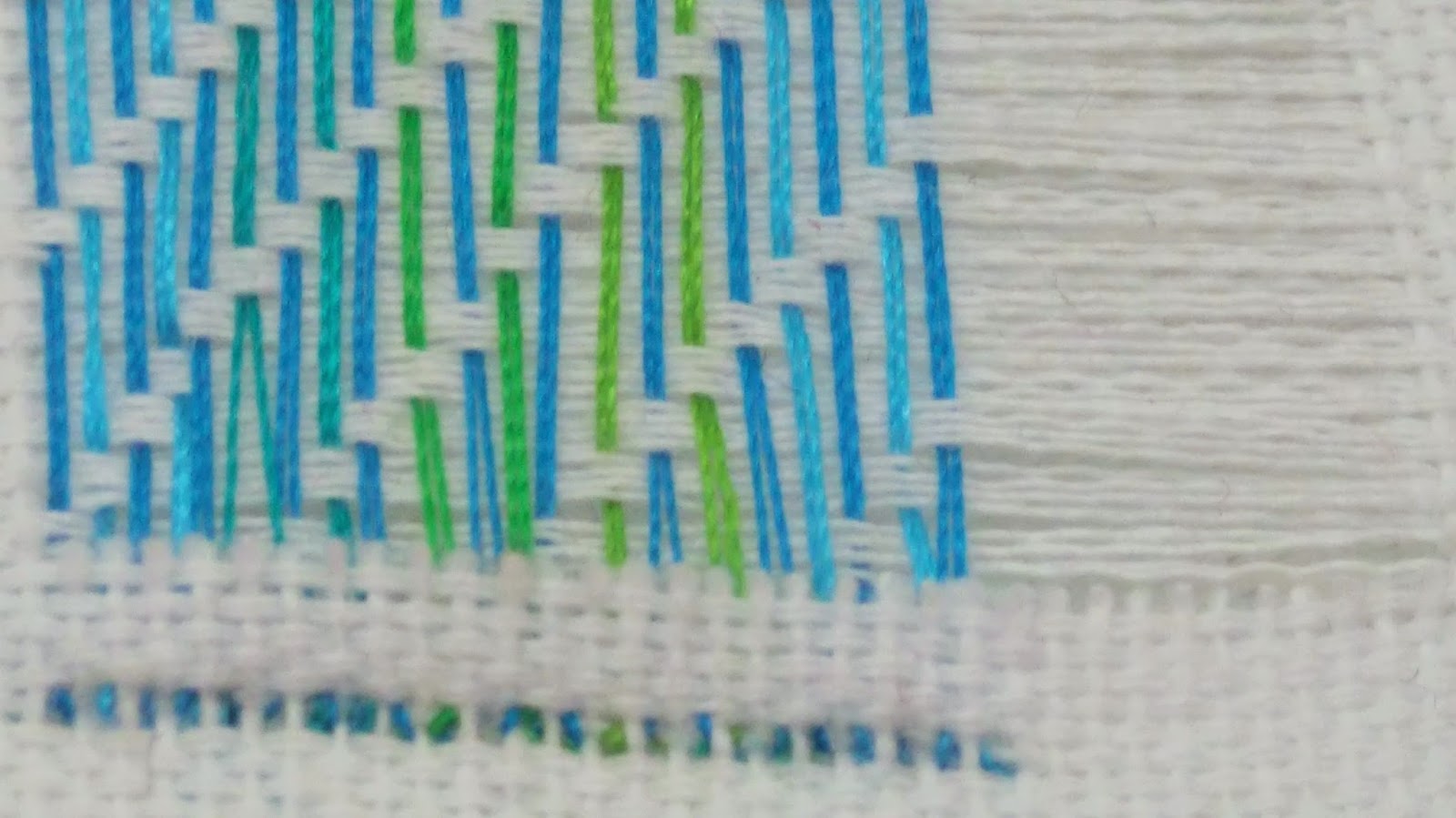
This unit I am going to develop some of the techniques inspired by my work for Gawthorpe Hall. I have created some more drawings based on research into old/traditional embroidery techniques, combined with my unique use of colour, inspired by my research into combating colour blindness and chromophobia. I am choosing specifically to focus more on patterns found in traditional darning and needleweaving.
Embroidered by Marie Terese Fourbisseur found in the Cooper Hewitt Collection: http://collection.cooperhewitt.org/objects/18489513/
Because my work is based on colour, my tutor thought it would be appropriate to enter me into the International Colour Competition run by the Society of Dying and Colourists. This was an absolutely amazing experience, and forced me to address how I present my work. I had very little time to throw together four boards that explained my samples. I also had to show that my work could be applied to a fashion context. This meant doing some visualisations and showing the process to reach them. I also had to make some executive decisions about the best way to present my boards. After some discussion with a few tutors we came to the conclusion it would be best to present my work onto a grey background instead of white because of the nature of my samples.


Not only did I enjoy a dye workshop and an excellent lecture on colour theory, but I also came away with a certificate of High Commendation from the judges as they we impressed with time, intricacy and detail that had gone into my work.

Although I think the techniques I used for Gawthorpe are very effective and create something really unique, the process is truly painstakingly slow. After a bit of fabric exploration I've found a handful of fabrics that have just the right weave, that I can snip out the weft. This speeds up the process slightly without losing the intricacy.


I have also entered some of my samples from the practice unit to be displayed as part of the TIP in Progress show in the art school. Although the brief for this show is large scale pieces, it is good they have offered to show smaller samples also. I hope my samples will be picked, they work well as a small collection so that might give them an edge.