Showing posts with label Unit X. Show all posts

Saturday, 21 May 2016

Evaluation

I have really enjoyed this unit. Although a lot of my work was very laborious, time consuming and mildly eye-sight destroying, I am really proud of the samples and final pieces I have produced. I feel like continuing my project using my colour based research from practice unit, meant I had a chance to really develop my stitch work.
Experimenting with different fabrics has been interesting and I found using machines to explore the qualities of my hand stitch to be very satisfying. I was pleased I managed to achieve the same intensity of colour with machine embroidery as I have in my darning and could make them at ten times the speed.
My final pieces are not what I expected to produce, but were reached through experimentation and I love the outcome. They reflect what initially inspired them (traditional embroidery samplers) and they offer the white space needed to allow you to focus on the detail.
Being entered into the Colour Competition run by the Society of Dying and Colourists was an excellent opportunity to learn about how to present my work for a specific brief and although I’m not sure what I entered was entirely appropriate to the brief I was forced to come up with creative solutions to avoid mounting white on white, keep within the four A2 board limit and trying to show my work as appropriate for a sustainable fashion context. I was very pleased to receive a judges High Commendation Award.
Having learnt from the Colour Competition I have created a well presented portfolio that allows you to see the front and back of my samples and gives each sample enough space to be appreciated. I have also been able to make sure you can see the narrative running through my work, being sure to include visualisation and drawings.
Although I really struggle with presenting my work, because of the hand drawn qualities and lack of uniformity, I feel like this unit I have made leaps with my presentational skills. Window frame mounting was not my favourite task, however it seems only appropriate that time-consuming presentation would be required for time-consuming samples.
I was also fortunate enough to have my samples picked to be displayed in the TIP in Progress Show which helped me see my samples in an exhibition context and gave me inspiration for how I might present my work at the Degree Show.

Finally having shown my four final pieces to the curators of the Gawthorpe Hall brief from Practice unit I have been offered the chance to exhibit in the Knit and Stitch Show 2016 alongside Manchester School of Art students and staff. I have been asked to create a larger scale, around 2 meter square piece with lots of my little pieces of darning. This is an exciting opportunity and will keep my practice ticking over after graduation, I plan to man the stand at both the London and Harrogate show with the hope that more opportunities will arise. 

Sunday, 8 May 2016

Finishing Touches

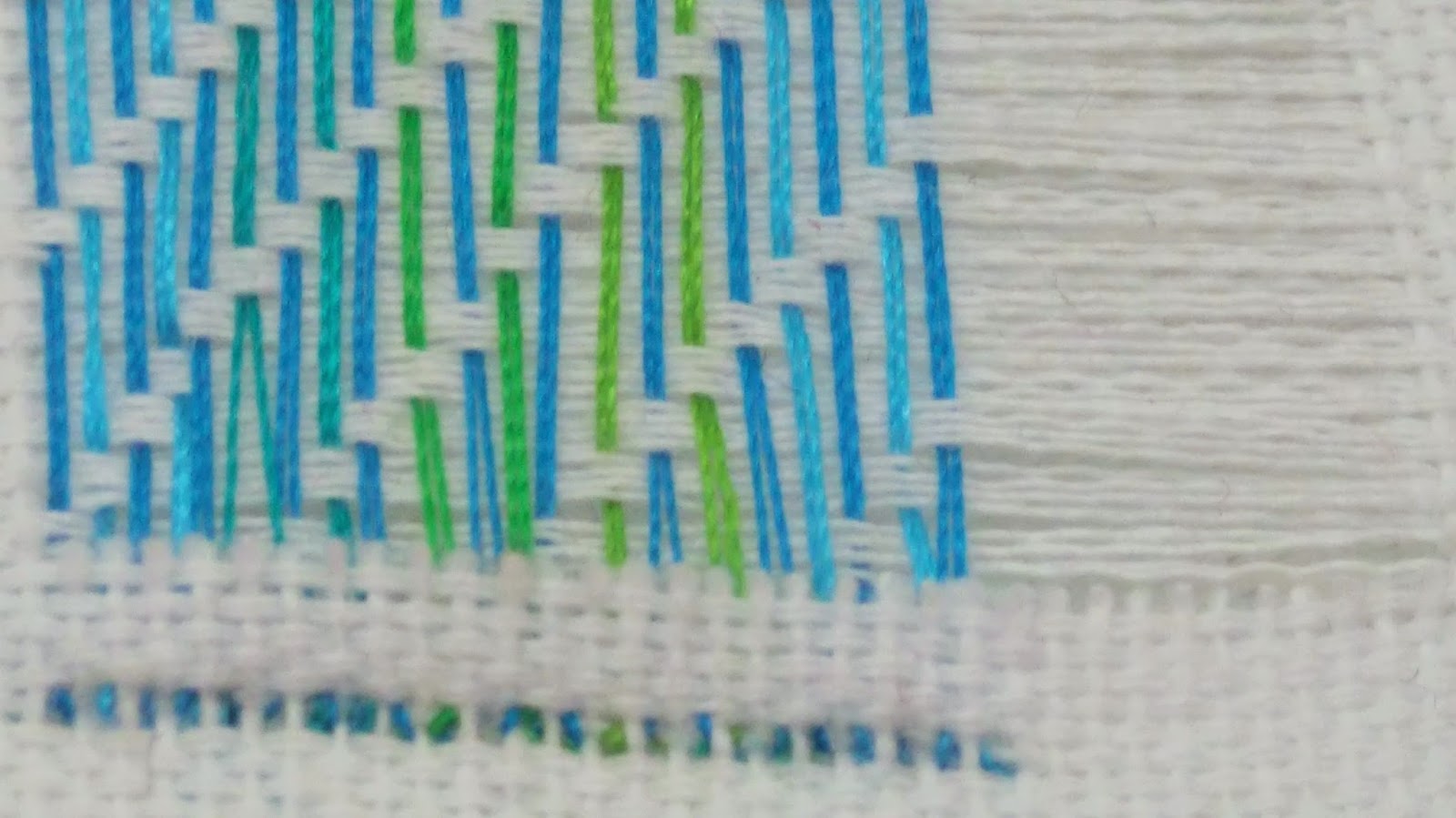
I have completed all four of my long samplers. The processes have been painstakingly slow, and the detail is minute but I think I have enjoyed creating larger compositional pieces. The intense colour works really well in the white/neutral space and I am really pleased with the outcomes.


This week I'm figuring out how my work will sit within the degree show. Having spoken to my tutor and attending a portfolio session I think it would be best if I could show my work hanging and laying on a table. All of this consideration has also lead me to think about the edges and finishing of my pieces. In order to try and ensure all my darning sits as it should, I have been testing out fabric starch and whether this would help fix my final pieces. However I think once the pieces are well pressed they should work fine without fabric stiffener, which ruins the drape of the fabrics. I am also having to experiment a little with the edging of my fabrics, finding the most effective solution being just to fray and trim the edges.

I got to see my samples displayed as part of the TIP in Progress show in the art school, neatly rolled in a glass cabinet. I think this is how my samples will be displayed on a table at the degree show if this is the kind of space I'm allocated.


I have also decided to create a collection of singular samples that can site alone. I enjoy displaying these as a kind of patchwork:


I may suggest this way of working for my large piece for the Knit and Stitch show.

I need to make some executive decisions about my portfolio this week - what size it will be A3 or A2 in consideration of how small my samples are. Whether samples need to be mounted or simply presented in a box. I also need to make a decision about the colour of paper things should be mounted on, whether grey like I used for the colour competition would be more appropriate or white.

Sunday, 27 March 2016

Creating Samplers

What initially started out as a practical measure, creating small samples on one long piece of fabric allowing me flexibility of how I could cut them up and present them later, now makes
sense as final pieces that imitate the old samplers that inspired them. This also offers an extra versatility to the context of my work. Their initial context of fabric that could inspire ideas for a range of techniques remains, however as longer pieces they can also be used as exhibition pieces that can be displayed in various ways.


Although the main focus of my body of work is still the delicate hand stitch and machine embroidery samples. I have taken lots of close up detail photographs of my work and manipulated them in photoshop to make digital prints. I have then shown these prints in various contexts.


After a month or so of waiting I have also finally heard back from the live brief at Gawthorpe Hall, and am very excited to be offered an exhibition space on the Manchester School of Art stand at Knit and Stitch Show in London and Harrogate. I will get to exhibit alongside four other students and MMU staff, including Alice Kettle. The tutors were very complimentary about the samples I put forward and have asked me to make a new piece over the summer especially for the show. They have asked me to complete a 2 meter by 2 meter piece with lots of my little coloured detail within. This will be a mammoth task but will give me something to work towards once I've graduated and I am looking forward to manning the stand in October and November. I look forward to a tutorial with the curators of the stand to discuss the best kind of fabric to use and the frequency of the detail I shall be adding.

Because the hand stitch techniques are so time consuming I have been looking alternative methods that could be used to create similar effects. This included an attempt at hand weaving on a frame using thicker yarns. Although I quite like the end result, this is not an appropriate technique for my work. It is only less time consuming if I use considerably thicker yarns, and the structure would become compromised if I were to get more adventurous than a plain weaving pattern.


Thursday, 25 February 2016

Developing work for unit X

This unit I am going to develop some of the techniques inspired by my work for Gawthorpe Hall. I have created some more drawings based on research into old/traditional embroidery techniques, combined with my unique use of colour, inspired by my research into combating colour blindness and chromophobia. I am choosing specifically to focus more on patterns found in traditional darning and needleweaving.
Embroidered by Marie Terese Fourbisseur found in the Cooper Hewitt Collection: http://collection.cooperhewitt.org/objects/18489513/
Because my work is based on colour, my tutor thought it would be appropriate to enter me into the International Colour Competition run by the Society of Dying and Colourists. This was an absolutely amazing experience, and forced me to address how I present my work. I had very little time to throw together four boards that explained my samples. I also had to show that my work could be applied to a fashion context. This meant doing some visualisations and showing the process to reach them. I also had to make some executive decisions about the best way to present my boards. After some discussion with a few tutors we came to the conclusion it would be best to present my work onto a grey background instead of white because of the nature of my samples.


Not only did I enjoy a dye workshop and an excellent lecture on colour theory, but I also came away with a certificate of High Commendation from the judges as they we impressed with time, intricacy and detail that had gone into my work.

Although I think the techniques I used for Gawthorpe are very effective and create something really unique, the process is truly painstakingly slow. After a bit of fabric exploration I've found a handful of fabrics that have just the right weave, that I can snip out the weft. This speeds up the process slightly without losing the intricacy.


I have also entered some of my samples from the practice unit to be displayed as part of the TIP in Progress show in the art school. Although the brief for this show is large scale pieces, it is good they have offered to show smaller samples also. I hope my samples will be picked, they work well as a small collection so that might give them an edge.

Monday, 18 May 2015

Reflections


This project has seemed backwards from our usual units. We had to come up with a context before we started sampling. I did not find this useful, because although I made the decision to make scarves I feel the work I produced equally fits an interior context as shown here:


I feel this way of working does not suit me very well because I feel like the fabric I create is more just a design to be bought and for the individual to decide its purpose, so assigning my ideas a product felt strange and limiting.

However deciding a final context did help some of the decision making such as materials and in terms of keeping the length of time each scarf took to make down, in consideration of keeping costs of labour reasonable and the overall price. Also choosing a “high end/designer” context helped me refine my fabric choices and to inform my scarf designs forcing them to have simplicity.  
I enjoyed doing visual research and allowed it to fully inform decisions such as fabric and techniques used. I found myself feeling more confident with this element of the unit than I have done previously and look forward to practising it over summer. I enjoyed the activities that allowed us to meet new people and see a variety of work, as I have mentioned in earlier posts, had I done these maybe a few weeks before having to make the decision of whether to collaborate, I think I would have done and enjoyed doing so. As for tutorials and feedback, I felt I was challenged as an embroidery student with little to no contact with even a textiles tutor, or other embroidery students during tutorials. However this did not deter me from taking part in feedback sessions and attempting to give feedback on things I felt I knew little about. It was nice that 3D and graphics students asked my opinion on their products as a fresh pair of eyes to their work and the processes available to them.  Finally I really enjoyed the experience of putting up the exhibition at the Federation House, helping people decide the best way to present their work and coming up with creative solutions to achieve that.

I feel I have developed massively in terms of contextual understanding, taking time to refine my use of colour (which would otherwise been much more eclectic) to suit the style of the high end/designer shop as well as making sure I use high quality fabrics. I feel like I better understand the importance of dying fabrics myself instead of using shop bought, which also comes from the desire to create a high quality/designer product.

My primary motivation for decision making was my visual research, when it came to making decisions about refining my work I was then motivated by my context. I also feel I considered the three words “personal, intelligent and playful” given to us in the brief as well as the idea of “limited edition”.


I am pleased with the choices I made regarding my materials and processes, they made excellent functional products. If I had more time and money I would like to have expanded my selection of designs that played with scale. Also I would have liked to develop a label or packaging for my product. Although my digital skills have improved since last unit, I feel designing packaging for myself would have been difficult in the time limit.
In the future I will be more confident in creating a final product in order to visualise a context but intend to take full advantage of sampling during future projects. I would also like to collaborate in future projects and might do so in order to brand myself.


Friday, 1 May 2015

Investigations

After some reflection over Easter and doing some samples, I have decided my product should be a scarf. I have produced some hand and machine samples using fabrics and embellishments suitable for this context.
Here I have hand sewn beads arranged so that they best represent "Plato's Disco" and it's shadow. I like this sample because of the heavy weight of the beads against the light Dupion silk fabric and the way this would affect the drape of a scarf:


This sample is cotton threads sewn down on water soluble fabric which I have then sewn 2/16 ply yarns across the empty spaces. Although I love this sample, the stitching is too heavyweight for use on a scarf and I fear if I were to try with less stitching it would not hold it's structure:


This a combination of the thicker 2/16 ply yarns and the variegated threads delicately stitched on the Irish machine. This creates a very bold impact and I think I will use to embellish the end of my scarves:


This sample is a variation on traditional kantha stitch using colour change thread to create diamond shapes:


Finally this is hand dyed patches of light cotton that I have sewn with contrasting grey thread using blanket stitch on the PFAFF machine:


A lot of the samples I have done produce a messy back so I did some embroidered scarf research to see how others have tackled this issue. I found Siobhan O’Brien, I really like her embroidered scarves.


Here she has used different coloured panels to make a double sided patchwork scarf.

So I have decided to make double sided scarves made up of patchwork panels, I need to buy my fabrics (I have decided on silk linen and dupion silk) and then cut these up into patches to be dyed separately both tonal greys and one side of a scarf to be brighter colours. I then need to get in the machine rooms and construct each side, embroider each side and then finally sew the scarves together.


After doing a narrative workshop with Alice Kettle I have realised how much more value is added to an object if it has a strong narrative. If I were to make packaging I would tell the story of my scarves, where they took their inspiration and the processes I have used to make them.
This workshop also taught me the benefits of collaboration. It was fun and interesting seeing what was inspired in other people’s minds by the objects we were given.

So far all of my tutorials have been with 3D tutors and predominantly 3D students. This has proven very interesting in terms of the kinds of suggestion I've got from them that seem focused on things like the final product and garment structure as apposed to advice concerning techniques, suggesting materials, sampling and alternatives to finished products. This focus is a new perspective and I think it's motivating me to produce a different kind of work.  


Wednesday, 25 March 2015

Research


I enjoyed our visit to the Whitworth and finding out more of what this brief is all about. I have chosen to do visual research based on the contrast of colour and tonal greys at the Whitworth. I have done this by picking out colours from pieces of work in the gallery, my favorite being "Plato's Disco". For my tonal greys, I have done drawings of the floor and from sections of paintings.


This is some of my visual research:


I intend to combine the colourful elements of my drawings with the tonal greys whilst sampling so I can get an idea of the best proportions for effective colour contrasts. I would like to experiment with a combination of kantha hand stitch, bead work and machine free motion machine embroidery. It will also be interesting to experiment with different weights and textures of fabrics too.
I am not yet sure which of the two shops I would like to create a product for, I feel like the children’s shop would be most suited to my intense colour use, but it might be nice to try and refine that and make something for the high end shop.


I think I would like to design either a scarf for the high end shop, fabric for a patchwork fat quarter pack for the high end shop or maybe a patchwork kit designed for the kids shop. If I choose to make a scarf I will need to make some decisions about whether it will be an evening dress scarf or a warm practical scarf. If I choose to make a pack of Whitworth fabric fat quarters for quilting, I will need to choose a lightweight but reasonably strong and durable fabric and will need to think about placement of stitching in terms of avoiding breakages in stitch work if the customer wanted to cut the fabric to size.  For the patchwork kit for kids I’d have to consider packaging and an instruction booklet for it to be successful.

I have enjoyed presenting myself to others with the intention of perhaps collaborating, which I don’t think I will end up doing, but it was a really good exercise and has made me more enthusiastic about the idea of collaborating in the future. I enjoyed the feedback back session and giving feedback to other students however didn’t feel the benefit due to the stark contrast in the way we are used to presenting our visual research and ideas on the textiles course opposed to those who do 3D or Graphics.