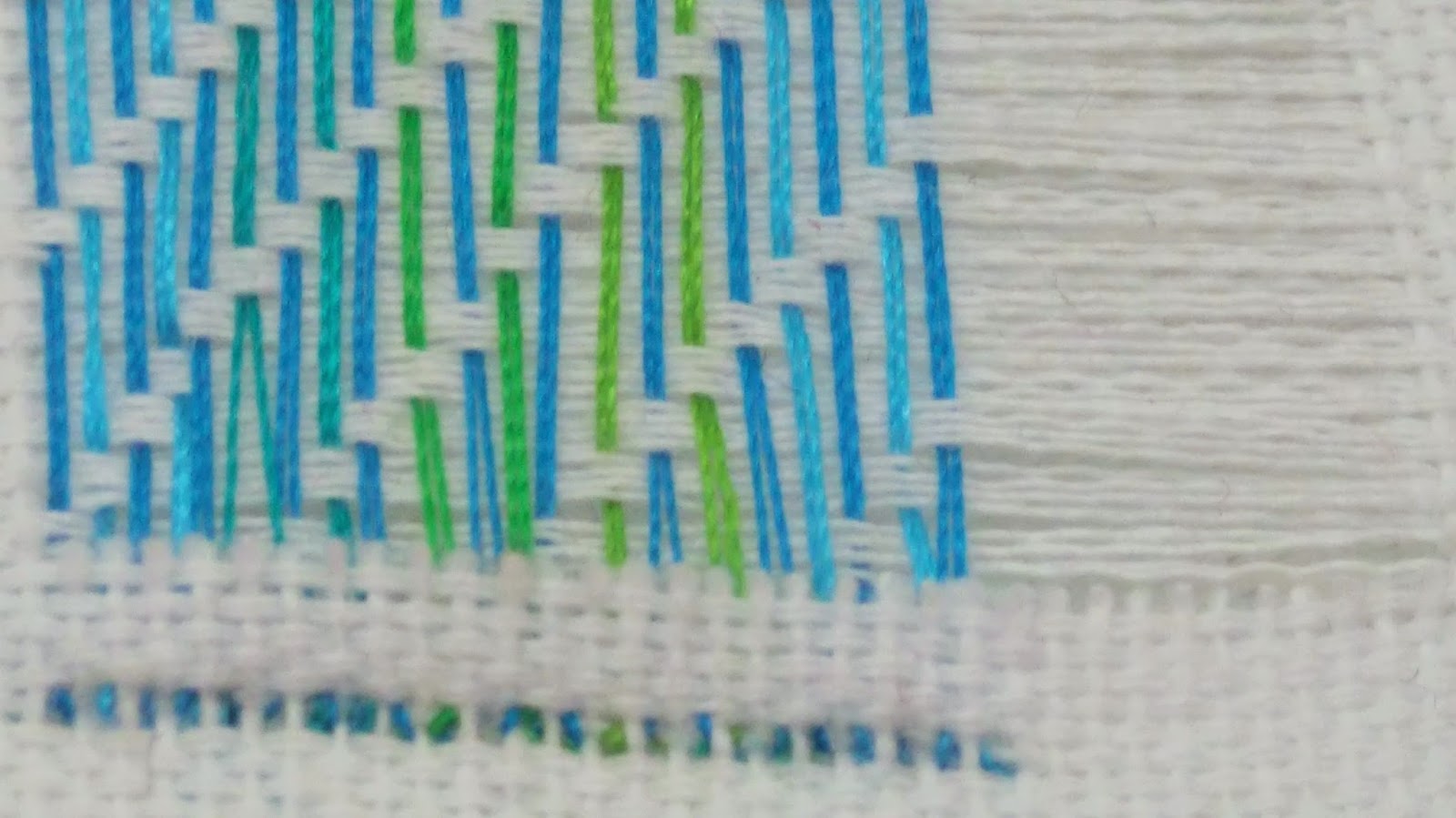
I have completed all four of my long samplers. The processes have been painstakingly slow, and the detail is minute but I think I have enjoyed creating larger compositional pieces. The intense colour works really well in the white/neutral space and I am really pleased with the outcomes.
This week I'm figuring out how my work will sit within the degree show. Having spoken to my tutor and attending a portfolio session I think it would be best if I could show my work hanging and laying on a table. All of this consideration has also lead me to think about the edges and finishing of my pieces. In order to try and ensure all my darning sits as it should, I have been testing out fabric starch and whether this would help fix my final pieces. However I think once the pieces are well pressed they should work fine without fabric stiffener, which ruins the drape of the fabrics. I am also having to experiment a little with the edging of my fabrics, finding the most effective solution being just to fray and trim the edges.
I got to see my samples displayed as part of the TIP in Progress show in the art school, neatly rolled in a glass cabinet. I think this is how my samples will be displayed on a table at the degree show if this is the kind of space I'm allocated.
I have also decided to create a collection of singular samples that can site alone. I enjoy displaying these as a kind of patchwork:
I may suggest this way of working for my large piece for the Knit and Stitch show.
I need to make some executive decisions about my portfolio this week - what size it will be A3 or A2 in consideration of how small my samples are. Whether samples need to be mounted or simply presented in a box. I also need to make a decision about the colour of paper things should be mounted on, whether grey like I used for the colour competition would be more appropriate or white.
Showing posts with label Outward Facing. Show all posts
Sunday, 8 May 2016
Sunday, 27 March 2016
Creating Samplers
What initially started out as a practical measure, creating small samples on one long piece of fabric allowing me flexibility of how I could cut them up and present them later, now makes
sense as final pieces that imitate the old samplers that inspired them. This also offers an extra versatility to the context of my work. Their initial context of fabric that could inspire ideas for a range of techniques remains, however as longer pieces they can also be used as exhibition pieces that can be displayed in various ways.
Although the main focus of my body of work is still the delicate hand stitch and machine embroidery samples. I have taken lots of close up detail photographs of my work and manipulated them in photoshop to make digital prints. I have then shown these prints in various contexts.
After a month or so of waiting I have also finally heard back from the live brief at Gawthorpe Hall, and am very excited to be offered an exhibition space on the Manchester School of Art stand at Knit and Stitch Show in London and Harrogate. I will get to exhibit alongside four other students and MMU staff, including Alice Kettle. The tutors were very complimentary about the samples I put forward and have asked me to make a new piece over the summer especially for the show. They have asked me to complete a 2 meter by 2 meter piece with lots of my little coloured detail within. This will be a mammoth task but will give me something to work towards once I've graduated and I am looking forward to manning the stand in October and November. I look forward to a tutorial with the curators of the stand to discuss the best kind of fabric to use and the frequency of the detail I shall be adding.
Because the hand stitch techniques are so time consuming I have been looking alternative methods that could be used to create similar effects. This included an attempt at hand weaving on a frame using thicker yarns. Although I quite like the end result, this is not an appropriate technique for my work. It is only less time consuming if I use considerably thicker yarns, and the structure would become compromised if I were to get more adventurous than a plain weaving pattern.
sense as final pieces that imitate the old samplers that inspired them. This also offers an extra versatility to the context of my work. Their initial context of fabric that could inspire ideas for a range of techniques remains, however as longer pieces they can also be used as exhibition pieces that can be displayed in various ways.
Although the main focus of my body of work is still the delicate hand stitch and machine embroidery samples. I have taken lots of close up detail photographs of my work and manipulated them in photoshop to make digital prints. I have then shown these prints in various contexts.
After a month or so of waiting I have also finally heard back from the live brief at Gawthorpe Hall, and am very excited to be offered an exhibition space on the Manchester School of Art stand at Knit and Stitch Show in London and Harrogate. I will get to exhibit alongside four other students and MMU staff, including Alice Kettle. The tutors were very complimentary about the samples I put forward and have asked me to make a new piece over the summer especially for the show. They have asked me to complete a 2 meter by 2 meter piece with lots of my little coloured detail within. This will be a mammoth task but will give me something to work towards once I've graduated and I am looking forward to manning the stand in October and November. I look forward to a tutorial with the curators of the stand to discuss the best kind of fabric to use and the frequency of the detail I shall be adding.
Because the hand stitch techniques are so time consuming I have been looking alternative methods that could be used to create similar effects. This included an attempt at hand weaving on a frame using thicker yarns. Although I quite like the end result, this is not an appropriate technique for my work. It is only less time consuming if I use considerably thicker yarns, and the structure would become compromised if I were to get more adventurous than a plain weaving pattern.
Thursday, 25 February 2016
Developing work for unit X
This unit I am going to develop some of the techniques inspired by my work for Gawthorpe Hall. I have created some more drawings based on research into old/traditional embroidery techniques, combined with my unique use of colour, inspired by my research into combating colour blindness and chromophobia. I am choosing specifically to focus more on patterns found in traditional darning and needleweaving.
Not only did I enjoy a dye workshop and an excellent lecture on colour theory, but I also came away with a certificate of High Commendation from the judges as they we impressed with time, intricacy and detail that had gone into my work.
Although I think the techniques I used for Gawthorpe are very effective and create something really unique, the process is truly painstakingly slow. After a bit of fabric exploration I've found a handful of fabrics that have just the right weave, that I can snip out the weft. This speeds up the process slightly without losing the intricacy.
I have also entered some of my samples from the practice unit to be displayed as part of the TIP in Progress show in the art school. Although the brief for this show is large scale pieces, it is good they have offered to show smaller samples also. I hope my samples will be picked, they work well as a small collection so that might give them an edge.
Embroidered by Marie Terese Fourbisseur found in the Cooper Hewitt Collection: http://collection.cooperhewitt.org/objects/18489513/
Because my work is based on colour, my tutor thought it would be appropriate to enter me into the International Colour Competition run by the Society of Dying and Colourists. This was an absolutely amazing experience, and forced me to address how I present my work. I had very little time to throw together four boards that explained my samples. I also had to show that my work could be applied to a fashion context. This meant doing some visualisations and showing the process to reach them. I also had to make some executive decisions about the best way to present my boards. After some discussion with a few tutors we came to the conclusion it would be best to present my work onto a grey background instead of white because of the nature of my samples.Not only did I enjoy a dye workshop and an excellent lecture on colour theory, but I also came away with a certificate of High Commendation from the judges as they we impressed with time, intricacy and detail that had gone into my work.
Although I think the techniques I used for Gawthorpe are very effective and create something really unique, the process is truly painstakingly slow. After a bit of fabric exploration I've found a handful of fabrics that have just the right weave, that I can snip out the weft. This speeds up the process slightly without losing the intricacy.
I have also entered some of my samples from the practice unit to be displayed as part of the TIP in Progress show in the art school. Although the brief for this show is large scale pieces, it is good they have offered to show smaller samples also. I hope my samples will be picked, they work well as a small collection so that might give them an edge.
Tuesday, 26 January 2016
Gawthorpe Hall: Refining Samples
This week I’m looking to take two main samples forward and
really refine them. I have been experimenting with needle weave in different
fabrics and in different scales.
I have also been creating more logcabin patchworks so that I
can see the full effect of the patches together and the patterns they create.
These are the two lines of enquiry I have chosen to explore for Gawthorpe Hall.
I have developed my Gawthorpe Hall samples. I have
created two collections, needle woven samples inspired by the beautiful darned pieces
from the archive and logcabin. I have taken inspiration from the colour palette of my
self-initiated brief and used much finer fabrics and threads to put my own
modern twist on these pieces. Until you have sat and repaired a damaged hole in a piece
of fabric do you truly appreciate the intricacy of it. We tend to take this for
granted these days because of the pace at which technology can produce it.
For my logcabin I have contrasted old recycled sari silk,
hand dyed cottons and modern fabrics such as PUC to give this old technique a
modern twist. I’ve also modernised the process, using the machine to quickly
and roughly patch these pieces together. I enjoy the effect this gives and
reminds me of the sample from the Gawthorpe archive marked by Miss Kay “do not
do it like this, it is wrong”.
Krista Jo Mustain Geometric wallhanging/coral quilt
2011/2012
Tuesday, 19 January 2016
Gawthorpe Hall: Experimenting
This week I have been doing some experimental samples inspired by the pictured I took at Gawthorpe hall and some drawings I have done from them.
This sample was inspired by some of the samplers, I decided to use the Pfaff to recreate a similar look.
I like that the same effect could be so easily replicated, however I think as a sample it's not that interesting. I could potentially develop it by sampling using my own colour scheme but it still would not really fit with the theme for the project which is "significcance".
My next sample was my own colour pallet applied to a darning sample:
Although I’m very pleased with the effect here, I think I
could develop it by working onto a white background and by giving the little
sections of darning more space. I feel like these samples will be more relevant to the theme of significance because darning is a means of repairing and we tend to only bother repairing things that carry significance to us. Also it takes an awful lot of patience and time to darn which creates a sense of significance in itself.
To modernise the
logcabin I have pieced new fabrics next to old, in order to create contrast. I
have also used only machine stitch to create these logcabin samples:
I feel like these logcabin samples also fit the theme of significance because they are made from upcycled fabrics that once had other purposes and carry their own meanings. I look forward to making a small collection of these little squares for this brief and perhaps taking them forward into the next project to make a garment or quilted piece.
Wednesday, 13 January 2016
Gawthorpe Hall
I really enjoyed the trip to gawthorpe hall, the collection
was really interesting and inspiring. The collection dated back as early as the
15th century, it’s absolutely amazing to see what the amazing things
people created completely by hand. It was however very frustrating that all of
the samples we kept in plastic wallets that meant that all of the photos of
samples are very low quality. Also the visit felt it was slightly lacking
seeing as we could not feel and have a play with the samples.
I was particularly
interested in the all of the impressive old hand techniques:
I intend to introduce
some of these techniques to display my colour palette. I have experimented with
logcabin, darning patterns and sampler structures. I have used the Pfaff
machine to imitate the sampler stitches, hand-dyed fabrics for the logcabin
samples and the Irish machine to help gather threads.
Monday, 14 December 2015
Dissertation
This week has been slow with practical work due to writing
my dissertation. I have found doing research into textiles and wellbeing really
interesting and came across a very interesting theory of colour called
chromophobia. This has inspired my practical work because I am very aware of my
bold colour use and how it could be seen as “too eclectic” or perhaps
unprofessional, but chromophobia is the idea that Western society has made
colour seem “foreign” or “childish” or “unprofessional”. Reading about this
social phenomenon helps me feel more confident in taking risks and challenging
these concepts of colour.
I have also found that doing my essay on wellbeing has been quite relevent to my self-initiated brief because of the gratification I have got from helping someone see a whole new colour. ot only has it contributed to my wellbeing, doing a project to help someone else, I also feel like it's may have helped improve his wellbeing taking time out to consider how he sees colour.
Finally it all seems relevant to my new live brief based on the Gawthorpe Hall Archives, which is full of amazing intricate hand embroidery done by people who will have used embroidery for the same wellbeing purposes we use it for today.
Saturday, 3 October 2015
Reflection
I am pleased with the board I have produced for the Bradford Brief, I am really like my needle weave sample however I feel like I need some more direction in terms of my context. I feel like designing for a collection of final samples is very difficult to communicate visually.
I found the two tutor crit this week really helpful. I
enjoyed hearing lots of fresh opinions on my work as well as suggestions for
new techniques. I am looking forward to developing my work further, I am
looking to increase the scale of my work by using printing techniques and found
fabrics. By using these techniques I should be able to create less time
consuming samples.
It will be really interesting to see how the scale of my work affects the intensity of colours.
I also got some helpful advice at other artists to look at that produce similar colour based work such as the Bauhaus Weavers:
https://uk.pinterest.com/explore/bauhaus-textiles/
https://couleurblind.me/2011/08/23/gunta-stoelzl/
I really love the colour use in these pieces and really relate it to the way I use it in my drawings. And although these are woven pieces I feel like they are particularly relevant to my constructed style of embroidery.
Saturday, 26 September 2015
Colour Curation
I had the opportunity to show my colour blind friend, who
sparked my self-initiated project, all of the samples I had made and it was
fascinating to hear what colours he could see. There were a few colours
(particularly the pale pink and the bright turquoise) that he saw to be a
different colour pretty much every time he came across it. It helped me see in
my own work how the surrounding colours have an effect on one stand-alone
colour. Also it was encouraging to hear that although he said it wasn’t very
obvious to him, he was starting to understand the concept of the colour purple
which he was previously completely blind to. Although I am not sure of the
final context for my work, it is really satisfying to have produced work that
has so positively impacted on someone’s life and quite literally their vision. This
has impacted on some of the research I have done for my dissertation and
encourages me to keep my eye out for arts/health and wellbeing opportunities in
the future.
I have also been offered the opportunity to exhibit my work in
collaboration with some Art History/Curation students which I am very excited
about. The exhibit is called “Curation of Colour” which is obviously a fitting
theme for my work. Having sent the curators images of my work they have offered
me a window space so that the light can really enhance my work. I am excited
about collaborating especially because they have not asked for a specific piece
to be made they just want to curate samples I have already made, so it will be
really interesting to see how they curate my work.
Subscribe to:
Posts (Atom)